


Ransomware is one of the biggest cybersecurity threats businesses face today. It’s no longer just a problem for big corporations—small and mid-sized businesses (SMBs) are also prime targets. Protect your business from ransomware—understand the risks and take steps to stay ahead of evolving threats.
“Ransomware isn’t just an IT issue—it’s a business continuity issue,” says John Unger, President of Vaultas. “A single attack can disrupt your entire IT ecosystem, damaging customer trust, revenue capabilities, and much more.”
The good news? You don’t have to navigate this alone. In this guide, we’ll walk you through:
- What ransomware is and why SMBs are at risk
- The financial, operational, and compliance risks of ignoring ransomware
- Simple, effective ways to strengthen your defenses
- The latest ransomware threats, including AI-driven attacks
What is Ransomware?
Ransomware is a type of malicious software designed to block access to files or entire systems until a ransom is paid. Attackers encrypt data, leaving businesses locked out of their own operations, often with a demand for payment in cryptocurrency. Some threats go further—if victims don’t pay, hackers may leak sensitive company or customer information online.
For most businesses, a ransomware attack starts with something seemingly harmless: an email attachment, a fake invoice, or a malicious website link. Once clicked, the ransomware installs itself quietly, encrypting files and spreading across systems before displaying a ransom note. By the time it’s detected, the damage is already done.
Ransomware has hit businesses of all sizes, including:
- WannaCry (2017): This global attack exploited Windows vulnerabilities, infecting 230,000 devices in 150 countries.
- Starbucks Payroll Attack (2024): A third-party provider was hit with ransomware, forcing Starbucks to revert to manual payroll and scheduling.
- KNP Logistics (2023): A 158-year-old SMB was forced to shut down after Russian hackers encrypted its data and demanded ransom.
As the above examples show, ransomware isn’t just a cybersecurity issue—it’s a direct threat to business survival.
Why Should SMBs Care About Ransomware?
Many SMBs assume they’re too small to be targeted by cybercriminals, but ransomware attacks don’t just hit large corporations. In fact, SMBs are prime targets. 46% of all cyber breaches impact businesses with under 1,000 employees.
A single attack can mean days—or even weeks—of downtime, lost revenue, and permanent damage to customer trust.
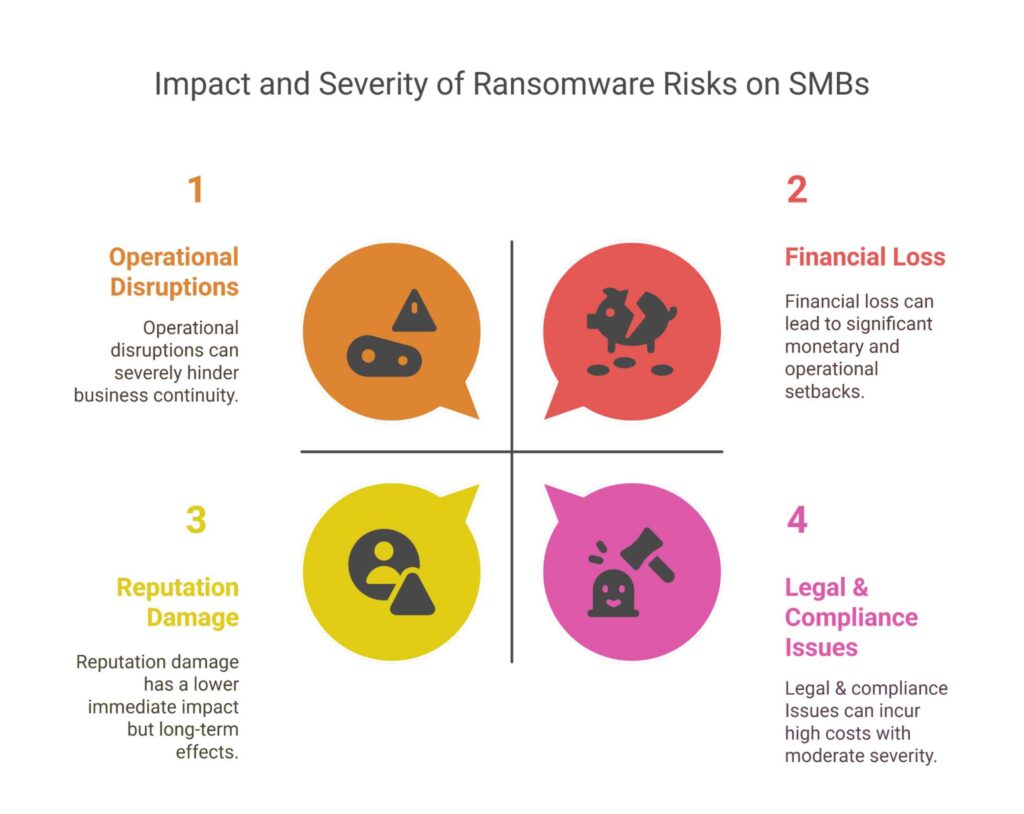
The risks of ransomware on SMBs go far beyond inconvenience:
- Financial loss: Ransom demands can range from thousands to millions of dollars, not including recovery costs.
- Operational disruptions: Encrypted files can lock businesses out of critical systems, halting operations entirely.
- Legal & compliance issues: If customer or financial data is exposed, businesses may face fines and legal action.
Reputation damage: Customers and partners may hesitate to work with a company that has suffered a breach.
The reality of ransomware is simple: SMBs can’t afford to ignore it. Cybercriminals are constantly evolving their tactics, and ransomware protection for small businesses should be a priority.
Fortunately, by taking proactive steps, you can significantly reduce your exposure to these attacks—and that’s exactly what we’ll cover next.
How to Protect Your Business from Ransomware
Managing ransomware threats and attacks can feel overwhelming, but taking the right steps now can reduce your risk and limit the damage if an attack happens. The key is to be prepared to prevent, identify, and mitigate ransomware activity using a layered approach.
No single solution will stop ransomware, but combining these best practices will make your business a much harder target. A list of proactive, effective ransomware management practices include:
1. Strengthen Employee Awareness
Most ransomware infections start with human error—a click on a phishing email, a download from an unfamiliar website, or the use of weak passwords. Educating employees about cyber threats and safe practices is one of the most effective ways to prevent an attack.
Some tips to consider include:
- Train employees to spot phishing emails, suspicious attachments, and fake links.
- Enforce strong password policies and encourage the use of password managers.
- Conduct regular security awareness training to keep employees informed of evolving threats.
- Run simulated phishing tests to identify and improve weak points in employee awareness.
2. Secure Your Data with Regular Backups
A strong backup strategy ensures that even if ransomware encrypts your data, you won’t lose everything. The key is keeping multiple copies in secure, isolated locations to prevent attackers from accessing them.
Follow the 3-2-1 backup rule:
- 3 copies of your data
- 2 different types of storage (e.g., cloud + external drive)
- 1 copy stored offline, disconnected from the network.
- Schedule automated daily backups for critical files and test them regularly.
- Ensure backup files cannot be modified by ransomware. (Use write-protected or immutable backups).
- Store backups in a separate network segment to reduce exposure.
3. Keep Software and Systems Updated
Outdated software is a prime target for cybercriminals. Keeping software updated is one of the most effective ways how companies can prevent ransomware from infiltrating networks. Hackers exploit vulnerabilities in unpatched systems to install ransomware and spread across networks. Regular updates close these security gaps before attackers can use them.
- Enable automatic updates on operating systems, applications, and security tools.
- Regularly apply security patches as soon as they’re released.
- Remove unsupported or outdated software that no longer receives updates.
- Use endpoint protection tools that detect and block exploits in real time.
4. Implement Strong Access Controls
The more people have access to sensitive data, the easier it is for ransomware to spread. Limiting access to only those who truly need it reduces the risk of an attacker gaining entry.
- Implement multi-factor authentication (MFA) for all critical accounts.
- Apply the principle of Zero Trust—only grant users access to what they absolutely need.
5. Strengthen Network Security
Many ransomware infections spread through weak network security, gaining access through open ports, misconfigured settings, or lack of monitoring. A layered network defense can help stop attackers before they gain entry.
- Use firewalls and intrusion detection systems to monitor and block threats.
- Disable Remote Desktop Protocol (RDP) if it’s not necessary, or secure it with VPNs and MFA.
- Segment your network—keep critical systems separate from everyday use.
- Restrict external access to sensitive data and systems.
6. Develop an Incident Response Plan
If an attack happens, having a clear response strategy is critical. How should companies handle ransomware? By having a well-prepared incident response plan that allows them to contain, recover, and restore operations efficiently.
- Assign specific roles—who handles containment, communication, and recovery? Establish a chain of command for decision-making during an attack.
- Have a list of contacts ready, including cybersecurity professionals, legal advisors, and law enforcement.
- Regularly test and update your response plan to reflect new threats and business changes.
Implementing these best practices can significantly reduce your exposure to ransomware. But cybercriminals are evolving their tactics every day. Up next, we’ll explore how ransomware threats are changing in 2025—and what your business needs to watch for.
Emerging Ransomware Threats
Cybercriminals aren’t slowing down in 2025—they’re adapting, improving, and finding new ways to bypass security measures. Businesses that rely on outdated protection methods are at greater risk than ever. Understanding these evolving threats is essential when considering how to protect your organization from ransomware in today’s landscape.
Here’s what’s changing in ransomware:
1. AI-Enhanced Spear Phishing
Hackers are using AI-generated emails and messages to impersonate executives, vendors, or employees with alarming accuracy. These attacks trick users into downloading malware or handing over credentials, leading to ransomware infections.
| How to combat AI spear phishing: ✔ Train employees to recognize hyper-personalized phishing attempts. ✔ Use email filtering and AI-based threat detection to catch suspicious messages. ✔ Implement multi-factor authentication (MFA) to prevent unauthorized access. |
2. Ransomware Attacks Designed for Total Shutdowns
Cybercriminals are shifting from data encryption to business disruption. Instead of just locking files, attackers now cripple entire networks, making recovery even harder. This tactic is especially damaging for industries that rely on real-time operations, such as healthcare and logistics.
| How to safeguard business continuity: ✔ Create an incident response plan to quickly contain and recover from attacks. ✔ Use network segmentation to prevent ransomware from spreading across systems. ✔ Maintain offline backups to restore operations without paying a ransom. |
3. Attackers Impersonating IT Staff
Hackers are infiltrating businesses by posing as remote IT support staff on platforms like Microsoft Teams and Slack. Employees who believe they’re speaking with their real IT department unknowingly grant access to attackers, who then deploy ransomware.
| How to prevent impersonation tricks: ✔ Verify IT support requests before granting access—even for internal teams. ✔ Use zero-trust security principles, requiring identity verification for all remote access. ✔ Limit admin privileges to prevent unauthorized software installations. |
4. New Ransomware Groups and Exploit Tactics
Emerging hacker groups are bypassing traditional phishing methods and focusing on software vulnerabilities instead. Groups like Ghost target unpatched systems, making security updates more critical than ever.
| How to stop organized ransomware: ✔ Enable automatic updates for operating systems and applications. ✔ Regularly scan for vulnerabilities and apply security patches immediately. ✔ Use endpoint protection tools to detect and block exploit attempts. |
Defend Against Ransomware with Vaultas
Ransomware is a growing threat, but you don’t have to face it alone. The best defense isn’t just having security tools—it’s having a trusted partner, like Vaultas, who understands how to protect your business from ransomware and ensure your IT ecosystem stays resilient.
Vaultas provides:
✔ Secure, scalable IT solutions designed to protect your business from evolving cyber threats.
✔ Reliable backup and disaster recovery strategies to keep your data safe and recoverable.
✔ Infrastructure security and business continuity planning to minimize downtime and disruption.
✔ Expert guidance and support so you always have a team ready to help when you need it most.
Cybercriminals are constantly adapting, but with Vaultas in your corner, your business stays ahead.
Get in touch today. Let’s build a ransomware protection strategy that works for you.